

| February 10, 2026
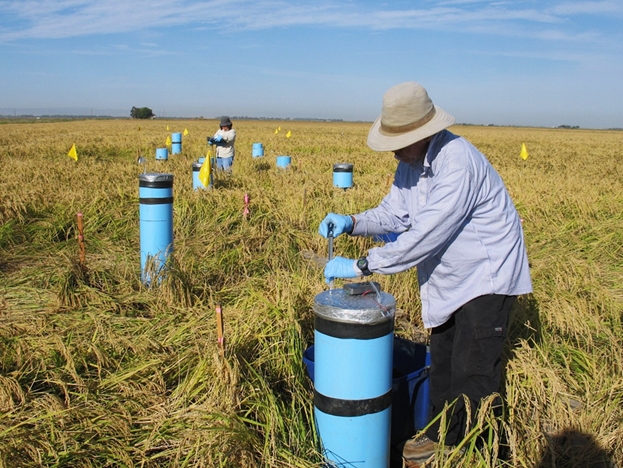
The chamber method is a technique used to measure greenhouse gas (GHG) emissions from surfaces by enclosing a specific area and measuring gas concentration changes over time. It is used to estimate CO₂, CH₄, and N₂O fluxes in agriculture. Commonly, it is a closed (static) approach, where a chamber is placed on an anchor covering soil, water or plants, depending on the experiment objectives. Gas samples are taken at predetermined intervals, and preserved for trace gas analysis in the laboratory.
The chamber anchor is a collar installed on the soil to prevent lateral gas leakage and may accept different chamber heights to accommodate for plant growth. In the case of flooded rice, the collar is designed to minimize its effect on water circulation.
Chambers are usually manually operated, starting with the closing of a well-sealed lid, which leads to increasing gas concentrations inside the chamber due to gas fluxes from soil. Gas samples are extracted from the chamber using air-tight syringes. Usually 3 to 5 samples are collected during a 30 to 60-minute period.
Chamber dimensions, materials and installation, as well as gas sampling procedures follow strict protocols designed to minimize errors and improve GHG flux estimations.